

WASHINGTON — Space is brutal. No air, nasty radiation, and wild temperature swings make the Moon a pretty terrible place for anything from Earth to survive.
But it turns out, we might be taking some tough little hitchhikers with us anyway.
According to a new report from Reuters, a recent NASA-led study found that some common, everyday bacteria and fungi could actually stay alive on the lunar surface.
Earth Microbes Could Survive on the Moon, Raising Contamination Fears Ahead of Artemis— New NASA modeling suggests common fungi like black mold could endure the harsh lunar environment, posing planetary protection challenges for upcoming crewed missions.
And not just for a few hours—for weeks, maybe even months.
As space agencies gear up to send humans back to the Moon, this brings up a massive headache: how do we keep our germs off of it?
Using data from a NASA orbiter, scientists ran computer models on five common microbes.
They wanted to see what would happen if these microbes got dropped near the Moon's South Pole, specifically in deep, permanently dark craters where it stays freezing cold.
Fungi, it turns out, are tough as nails.
The biggest survivor in the test was Aspergillus niger. If that sounds familiar, it's basically the common black mold you might find in a damp bathroom.
It’s even been found hanging out on the International Space Station.
In NASA's models, this mold survived the freezing lunar winter just fine as long as it had some shadow. Another common dirt fungus, Fusarium, held its own too.
The bacteria, on the other hand, didn't do so hot.
Even strains known on Earth for surviving extreme radiation basically got cooked by the Moon’s unfiltered UV sunlight.
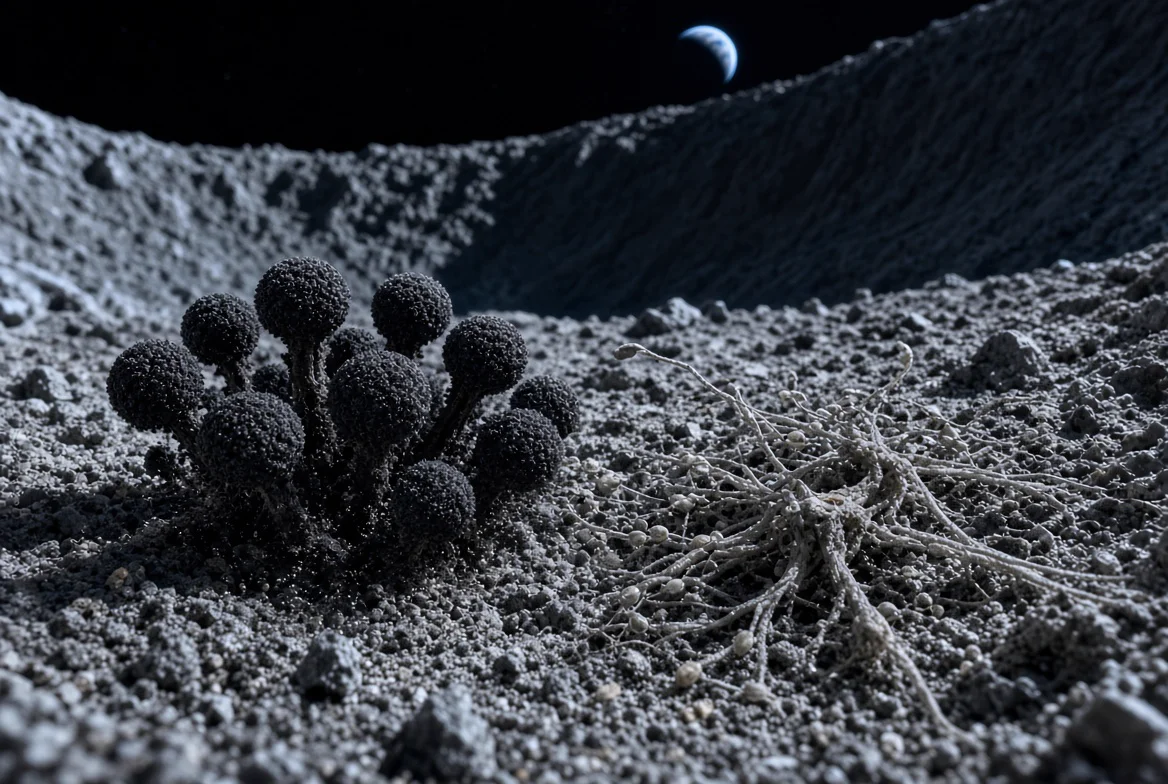
Visualization produced by advanced high-fidelity generative computational systems to illustrate peer-reviewed findings on terrestrial microbial survival in lunar polar environments.
The Contamination Problem
Human bodies are walking petri dishes. We are covered in trillions of microbes.
Going to space without bringing at least a little bit of bacteria along is pretty much impossible.
Astronauts could easily leave trace amounts behind on their space suits, rovers, or tools.
Researchers made it clear they only looked at whether these microbes could survive—not if they would grow, spread, or mutate.
But just staying alive is enough to cause a problem.
Both the US Artemis program and China's space program are eyeing the Moon’s South Pole right now. Why? Because there's water ice hidden in the shadows.
If Earth germs get into that ice, it messes up the science.
Imagine drilling a sample, finding a microbe, and thinking you just discovered alien life—only to realize it fell off an astronaut's boot.
That’s exactly why scientists are warning that we need a strict inventory of the exact bacteria we’re taking with us.
Otherwise, we won't be able to tell what's actual lunar chemistry and what's just our own trash.
Related