The Phrase
In ancient Middle Eastern moral philosophy, there is a specific warning about the worst kind of human failing: the person who is simultaneously an oppressor and profoundly ignorant. But the profound question is rarely asked: why both? Why not simply warn against the oppressor? Why not simply warn against the ignorant? Why does the warning only carry its full weight when both are named together? The answer turns out to be one of the most precisely accurate descriptions of dangerous human behaviour that modern neuroscience and sociology have ever mapped.Part I: The Logic of the Combination
To understand why both concepts are necessary, we must first understand what each trait alone implies — and critically, what excuse each trait alone leaves open. The Conscious Oppressor is dangerous, but knowingly so. Their wrongdoing carries with it the seed of its own limitation. They know. That knowledge is a friction point. It creates cognitive dissonance, the possibility of guilt, the potential for calculation. Society has tools for them: punishment deters, shame reaches, consequences can stop them. The Purely Ignorant causes harm, but without malicious intent. Classical philosophy has always treated ignorance as a mitigating factor, because the ignorant can, in principle, be corrected. Show them the harm clearly enough, educate them sufficiently, and the harm stops. They are not unreachable. But the Ignorant Oppressor removes both escape routes. They wrong others with active agency, and they are constitutionally unable to perceive it as wrong. There is no guilt to leverage, no shame that lands, no punishment that teaches. This combination is not the sum of two dangers. It is an entirely different, categorically worse phenomenon. And modern science has now proven exactly why.Part II: The Neuroscience Proof
The Dunning-Kruger Effect — The Scientific Name for Blind Ignorance
In 1999, psychologists David Dunning and Justin Kruger published a study proving something simple but devastating: people with the least competence have the greatest confidence in their own correctness. But more than that — incompetent people lack the very metacognitive ability needed to recognise their own incompetence. They are not just wrong. They are structurally unable to know they are wrong. This is not stubbornness. It is a cognitive architectural deficit. The Dunning-Kruger effect is the scientific name for this exact type of ignorance — not merely "not knowing," but being neurologically unable to know that you do not know.Anosognosia — When the Brain Cannot See Its Own Dysfunction
Neurologist Joseph Babinski and later V.S. Ramachandran extensively documented a condition called anosognosia — from the Greek meaning "without knowledge of disease." In this condition, a person has a real deficit, and their brain actively denies it. A patient with a paralysed arm will sincerely insist the arm is fine. This is not lying. The brain literally cannot perceive its own dysfunction. Applied to the Ignorant Oppressor, this becomes what we might call moral anosognosia — the circuits that would signal "I am doing wrong" are either damaged, underdeveloped, or suppressed. The cruelty is real. The blindness to the cruelty is also real, and it is neurological. This is why such a person cannot simply be told they are wrong. The receiving apparatus is broken.The Closed Feedback Loop
When oppression and ignorance combine, they form a self-sealing system. The person commits harm. Their self-monitoring system fails to register it as wrong. No guilt fires, no dissonance arises, no friction slows them. The self-serving bias then actively confirms they were correct. Their confidence increases. They commit further harm with even greater certainty. And the loop begins again. This is a runaway system mapped onto specific brain structures. Research by Schulze et al. (2013) using MRI found reduced grey matter in the left anterior insula — the region responsible for empathy — in individuals with exploitative profiles. Baskin-Sommers et al. (2014) found reduced anterior cingulate cortex activity when such individuals made errors. The ACC is the brain's error detection system. In these individuals, the moral alarm is functionally offline. The blindness is written into the brain's architecture.Part III: The Hierarchy — Which Type Is Most Dangerous?
Ranked from least to most dangerous, the scientific and sociological verdict is clear. The purely ignorant alone is the most redeemable — the harm has no malicious root, and the right environment corrects it. The conscious oppressor alone is dangerous but self-limiting — internal knowledge of wrongdoing creates a ceiling. But the Ignorant Oppressor is categorically most dangerous — because they are neurologically self-sealing, sociologically self-reinforcing, and institutionally the most destructive. They cannot be deterred by punishment they experience as unjust persecution, or reached by shame they reframe as the jealousy of lesser minds. Hannah Arendt described this exact profile in what she called the Banality of Evil — her portrait of Adolf Eichmann, the Nazi bureaucrat who organised mass deportations. He was not a monster in the traditional sense. He was not driven purely by hatred. But he had a complete inability to think from the perspective of others, combined with industrious harmful action, and a sincere belief that he was performing his duties correctly. Arendt's conclusion was devastating: thoughtless action plus moral blindness is more destructive than conscious evil. A conscious monster can be identified and stopped. An Ignorant Oppressor does not even register as a monster — to others, or to themselves.Part IV: The Educated Idiot and the Narcissist — Modern Clinical Names for an Ancient Diagnosis
Narcissistic Personality Disorder
Formally established in DSM-III, Narcissistic Personality Disorder maps onto the Ignorant Oppressor with extraordinary precision. The narcissist's grandiosity is active oppression — they act as if rules do not apply — and their lack of empathy means they are neurologically unable to perceive the harm landing. When confronted, they DARVO: Deny, Attack, Reverse Victim and Offender. They become, in their own narrative, the most wronged person in the room. The oppression continues. The ignorance intensifies. They now have a grievance narrative that fuels further harm.The Intellectual Yet Idiot
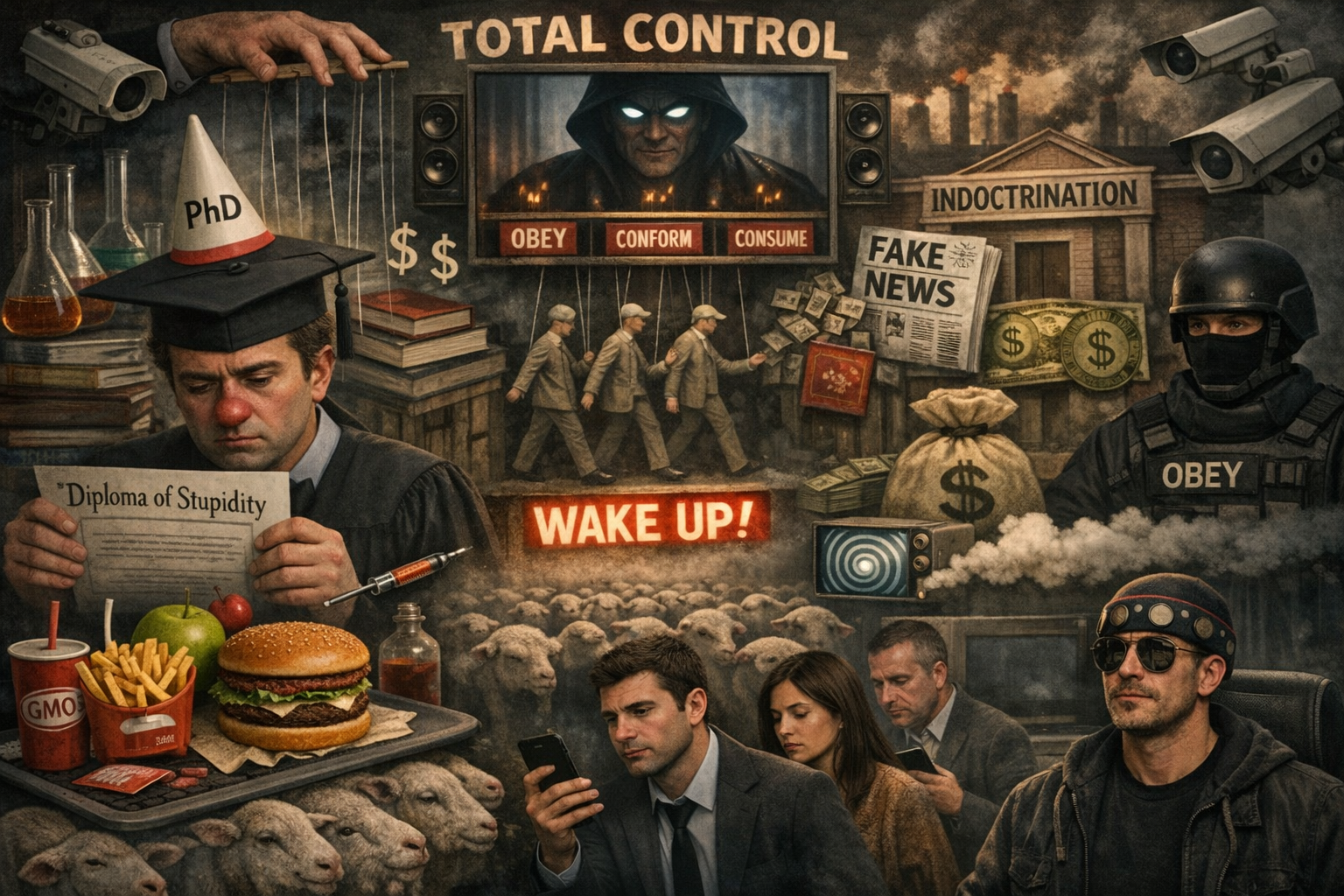
Nassim Nicholas Taleb, in Skin in the Game, described what he called the Intellectual Yet Idiot — a profile that matches this archetype in its most institutionally dangerous form. The IYI carries formal credentials and fluent professional language. They do not know that they do not know. They cause harm at no personal cost, because they have no skin in the game — they never personally experience the consequences of their decisions. They mistake credentialism for wisdom and institutional consensus for truth. Researcher Ottati et al. (2015) documented the Earned Dogmatism Effect — the finding that experts who feel their credentials are validated become more closed-minded, not less. The credential is experienced neurologically as permission to stop questioning. This is how formal education manufactures blindness at scale.Part V: The Classroom, The Home, and the Prussian Ghost
The most intimate and daily manifestation of the Ignorant Oppressor is not in politics or war. It is in the classroom and the home — in the parent who screams at a child for not completing homework, and in the teacher who assigns it, both of them certain they are doing good, neither of them capable of questioning what "work" or "knowledge" actually means.What the Research Actually Says About Rote Homework
Alfie Kohn, after reviewing decades of studies in The Homework Myth (2006), concluded there is no consistent evidence that homework improves academic achievement in primary or middle school. John Hattie's meta-analysis ranked rote homework's effect on genuine learning as minimal to negligible. What copying notes and mechanical drills reliably produce is not knowledge — it is anxiety, resentment toward learning, and a damaged relationship between the child and curiosity itself. Cognitive scientist Robert Bjork distinguishes between performance — doing well on a task right now — and learning — durable change in long-term understanding. Copying produces performance. It produces almost no learning. The brain encodes genuine knowledge through retrieval practice, desirable difficulty, and meaningful application. None of this happens when a child copies from a textbook at ten in the evening under threat of punishment.Paulo Freire and the Banking Model
Paulo Freire, in Pedagogy of the Oppressed (1968), described the Banking Model of education — the treatment of the student as an empty vessel to be filled with information, whose role is to receive, memorise, and repeat. Freire explicitly called this oppression — not metaphorically, but structurally — because it denies the child's humanity and trains them to silence their own curiosity. And his most chilling observation: the oppressor in this system does not see himself as an oppressor. He sees himself as generous — giving knowledge to the empty child. The blindness is complete.The Prussian Educational Legacy
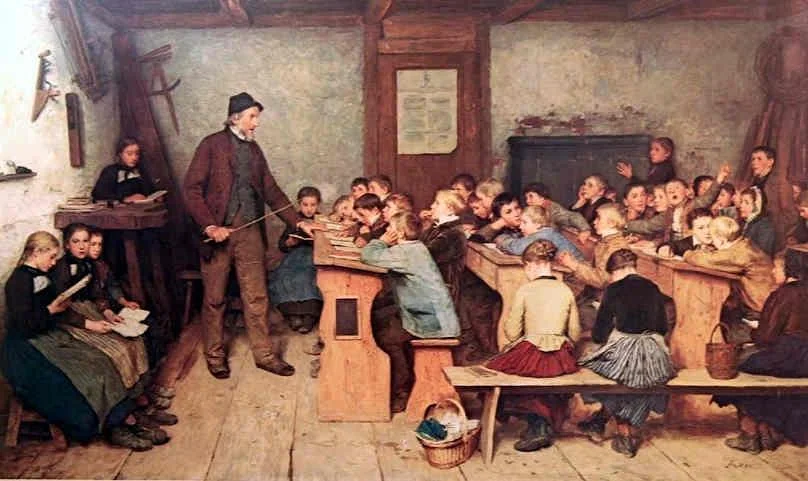
The modern school system, engineered in 18th and 19th-century Prussia, was not built to educate free thinkers. It was built to produce obedient, skilled workers and soldiers for a militaristic state. It was characterised by rote memorisation, verbatim copying, punishment for wrong answers, heavy homework loads, and the teacher as an unchallengeable authority figure — all deliberately designed to produce predictable, compliant minds. The most tragic outcome of this system is what it did to every generation after. The teachers and parents who were processed by this system did not just absorb its content. They were trained to believe that this is what education is. They cannot question a framework they were never given the tools to see. Their ignorance was manufactured with industrial precision. But when they enforce it on their own children — despite the child's suffering, despite evidence, despite calls for change — the inherited ignorance becomes active oppression. They have graduated from victim of the system to agent of the system.What Happens to the Child
The child inside this system arrives with a natural disposition toward curiosity, wonder, and meaning. The system punishes that curiosity and rewards copying. The child learns that their thinking has no value. They learn that compliance equals survival. And eventually, they become the next institutionalised adult — a person whose love of learning was extinguished before it could form, who will one day enforce the same emptiness on their own children, in the full belief that they are being a good parent. The greatest harm of the educated idiot is not what they do to the child today. It is that they manufacture the next generation of the Ignorant Oppressor.Part VI: Why This Research Matters
This ancient philosophical archetype was not describing a simple bad person. It was describing a psychological and sociological reality that modern clinical psychology named Narcissistic Personality Disorder, modern sociology named the Institutionalised Idiot, modern neuroscience mapped onto specific brain structures, and modern organisational theory identified as the root of institutional evil. And it is what millions of children experience every day at the hands of people who love them, who hold degrees, and who have never once questioned what the word knowledge actually means. That is the educated idiot. That is the institutionalised oppressor. And the child sitting at the table, copying meaningless notes at ten in the evening, knows more truth about education in that moment of suffering than the adult standing over him ever will.Related Articles