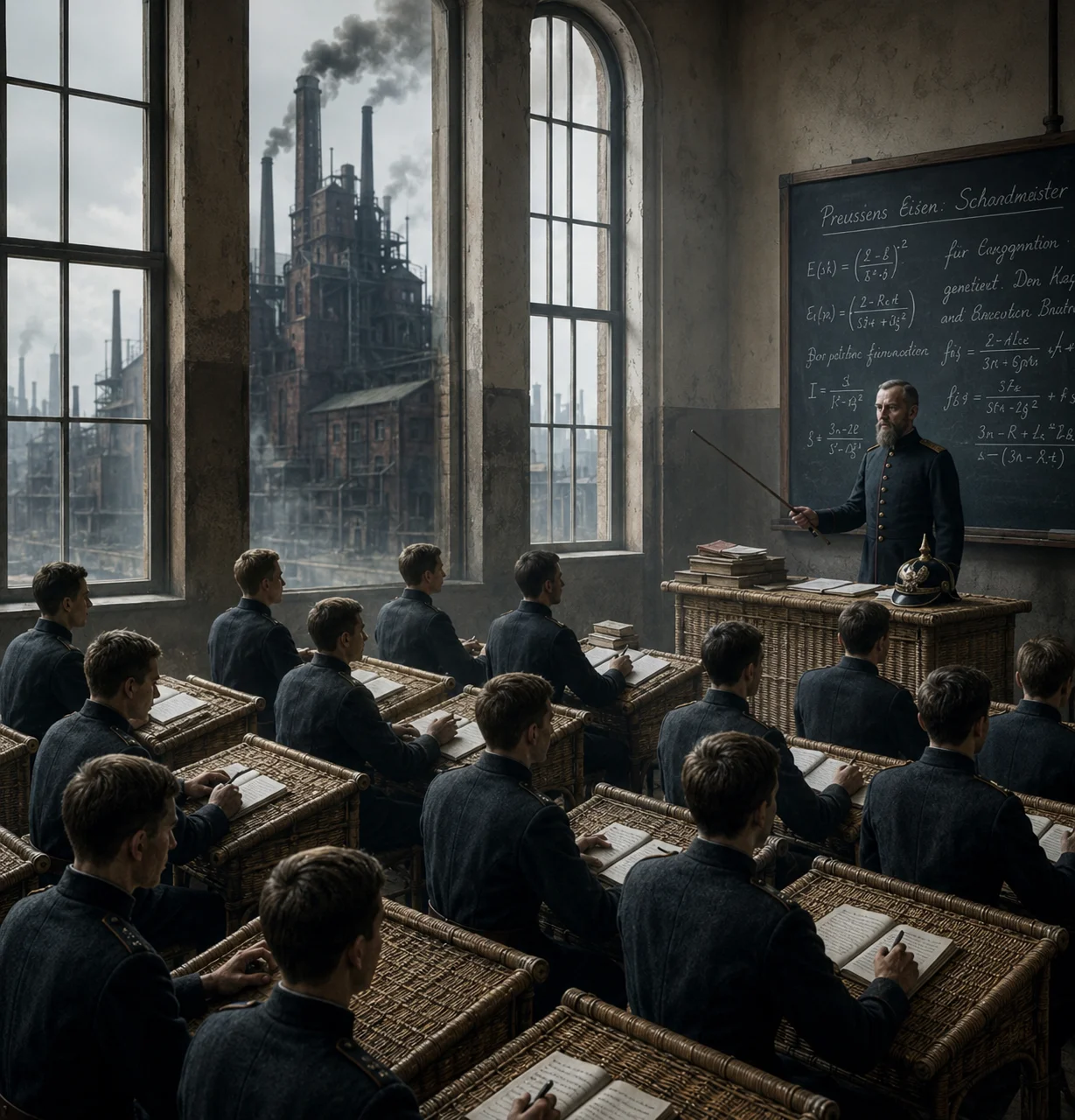
Why modern education mimics the form of learning while destroying the essence of critical thought, tracing the lineage from the industrial-age Prussian school system.
Content Advisory: This report contains developing information that is actively being verified.
FeaturingRichard Feynman (American Theoretical Physicist), John D. Rockefeller (American industrialist who shaped the US General Education Board.), Frederick the Great (Prussian King who pioneered the mandatory schooling model for obedience.), Albert Einstein (German-born theoretical physicist)
Walk into almost any high school science class and you will find the Bohr model of the atom and the periodic table taught as if they were absolute, unquestionable laws handed down from the heavens. Students aren't taught how physicists actually reasoned their way to the atom; they are simply told what it is, then ordered to memorize electron configurations to pass their Paper 2 exams. Niels Bohr would probably be horrified to see that modern schools have replaced medieval religious dogma with a new kind of scientific dogma. By scrubbing away the historical doubts, the mistakes, and the fierce debates, school textbooks lie to students about how science actually works.
This dogmatic approach completely ruins the school science lab, turning what should be an open-ended exploration into a hollow, frustrating ritual. In practice, school science labs suffer from three major systemic issues:
First, the answer is already written down. Students are given a rigid recipe to follow. Before they even light a Bunsen burner or release a pendulum, they already know exactly what the chemical reaction or the swing is supposed to do. There is no actual discovery involved; it's just kitchen cooking without the food.
Second, the system punishes reality. In the real world, a failed experiment is often a massive scientific breakthrough—it means your hypothesis was wrong and you are about to learn something new. In a school lab, if your results don't perfectly match the textbook, you are penalized. You lose marks because your physical equipment behaved like the real world instead of an idealized classroom model.
Third, it teaches kids to lie. Because students know exactly what their graph has to look like to earn an 'A', they quickly learn to cook the books. They tweak their measurements, ignore outliers, and draw a perfect line of best fit through entirely fabricated data points. The school lab doesn't teach scientific integrity; it teaches bureaucratic compliance and creative bookkeeping.
Albert Einstein wrote this to his early mentor, Jost Winteler, on July 8, 1901. Translated from the original German ("Autoritätsdusel ist der größte Feind der Wahrheit"), it remains a stark warning that unquestioning trust in authority is the quickest way to kill independent thought.
This hollow mimicry is exactly what physicist Richard Feynman called "Cargo Cult Science." During his 1974 Caltech commencement address, Feynman described the Pacific islanders who, after World War II, tried to summon back the military transport planes that had brought wealth and supplies during the war. Having watched soldiers run airfields, the islanders built incredibly detailed, mock runways out of bamboo and straw. They put wooden headphones on "air traffic controllers" who sat in bamboo towers.
To an outside observer, it looked exactly like an airfield. But the planes never landed, because the islanders replicated the superficial forms of aviation without understanding the underlying physics, logistics, and global networks that made the real planes fly.
Feynman pointed out that much of what we call science operates the same way. It has all the formal trappings—the technical jargon, the expensive measuring equipment, the formal lab coats—but lacks the core element of "utter honesty." True science requires a ruthless commitment to questioning your own assumptions, especially because, as Feynman famously said, "you are the easiest person to fool."
Our modern education system is essentially a massive, institutionalized cargo cult. Its structure didn't evolve to create independent, critical thinkers. Instead, it is still running on the architecture of the 19th-century Prussian model, which was specifically engineered to produce compliant soldiers, submissive factory workers, and loyal civil servants.
This framework was later enthusiastically imported to the United States by industrial philanthropists like John D. Rockefeller, who famously remarked, "I don't want a nation of thinkers, I want a nation of workers." To manage an industrial-scale population, these reformers turned to standardized testing. It was a highly efficient, factory-style tool for sorting people, but in doing so, they narrowed the entire scope of education to what could easily be measured on a bubble sheet.
When schools focus entirely on "teaching to the test," they build their own bamboo control towers. Students learn the elaborate rituals of academic success: they memorize specific facts, practice elimination strategies for multiple-choice questions, and regurgitate precise keywords to satisfy grading rubrics.
The "cargo" they are chasing is a good grade, a high percentile, and a piece of paper that promises a stable job. But the external markers of academic success don't mean actual learning has taken place. We end up graduating students who are experts at finding the "right" answer on a multiple-choice sheet, but completely lost when asked to formulate a logical question of their own.
If we want to move past this cargo-cult education, we have to change what we value in the classroom. We need to build environments where questions are worth more than pre-packaged answers, where skepticism of authority is encouraged, and where failure is treated as a necessary step in the learning process rather than a permanent black mark on a transcript.
Just as mock runways of straw and bamboo will never land a real plane, a school system that merely mimics the appearance of learning will never produce truly educated minds. If we want our students to build real intellectual engines of their own, we have to start by having the courage to tear down the fake airfields.